• Skip to primary navigation
  • Skip to main content
  • Skip to primary sidebar

Pagibig Financing

Pag-IBIG Fund, Housing Loans, Mortgage, Membership, Foreclosures, etc

  • Home
  • FAQ
  • Marketplace
  • Contact Us
  • Subscribe

Pag-IBIG Financing Admin

Mortgage Calculator and Amortization Schedule… Plus, How To Save On Your Loan Payments

by Pag-IBIG Financing Admin

In the previous article about amortizations, you learned how to determine the monthly amortization given a particular loan amount, loan term (in years) and interest rate (per annum).

It is very important to bear in mind that these three factors primarily determine the scheduled amount of the monthly amortization.

This article somehow extends on the previous one and here I’ll discuss the following topics with the help of an online mortgage calculator, which is also included here:

  • How to generate the Monthly Amortization Schedule.
  • The two components that go into the monthly amortization: interest and principal dues.
  • As the title of this article says, “How to save on your loan payments.”

The Mortgage Loan Calculator

With the help of the Mortgage Calculator shown below, let’s see how the amortization schedule looks like on a monthly basis.

Important Note When Using The Mortgage Calculator: When you click on the Calculate Button, the result displays in a pop-up window. To close the window, simply click the Close Button located at the upper right corner of the resulting pop-up window.


Powered by Auto Loan Calculator

As you can see, the tool has some default values already and if those values perfectly match your loan, all you have to do is click on the Calculate Button to show the results. But for most of us, our cases are of course different from the default example.

Let’s say your property costs P 2,000,000 and you are to put 20% down payment up-front — that should be P 400,000 out of your pocket. Furthermore, let’s say that the going interest rate in the market is 10.5% per annum and that you plan to pay the PhP 1,600,000 loan in 3 years only. From here, you want to determine the following:

  • Monthly Amortization Amount
  • Monthly Amortization Schedule

If you have entered the right values from the calculator shown above, you should get the monthly amortization at PhP 52,003.91 and that the total amount paid in interest for the whole 36-month duration of the loan should be PhP 272,140.75 (see at the bottom part of the resulting Amortization Table).

Here are some graphics to visually guide you on the results.
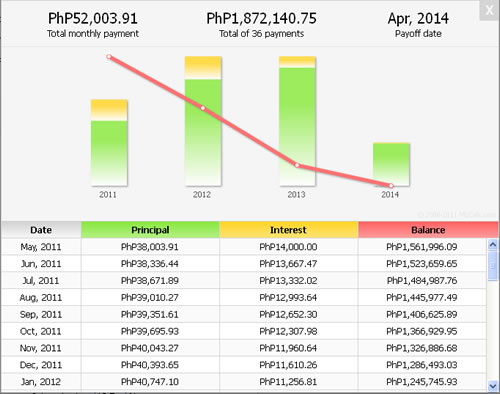
Monthly Amortization Schedule Table

Figure 1 : Monthly Amortization Table for P 1.6M loan payable in 3 years at 10.5% interest rate.

The Amortization Table above only partially shows 9 months out of a total of 36 months amortization schedule.

You will find the total Principal and Interest Payments at the bottom of the Tabular data when you scroll it down. It should look like this on your screen:
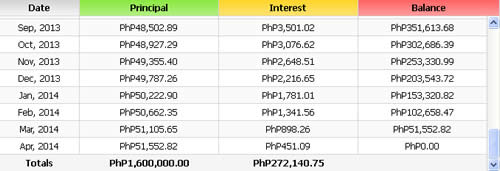
Pag-IBIG Loan Table

Figure 2 : Monthly Amortization Table continued from the previous Table. This time, only the last part of the amortization schedule is being shown.

If your results don’t match with this one, please do it all over again until you get it right. This is a very powerful tool of analysis right at your disposal.

More On Interest and Principal Dues

Take another look at the resulting Amortization Schedule Table.

If you add up the Interest amount due and the Principal amount due at any row, it always results to 52,003.91.

That magic number is not at all magical. That’s your monthly amortization!

In other words, the amortization consists of two components, namely: the principal due and the interest due. Each payment that you make against your scheduled amortization, a portion of it goes to the principal payment and the other portion goes to the pay the interest.

From the example above, your first monthly payment of 52,003.91 pays for the PhP 14,000.00 interest and the PhP 38,003.91 principal. On the second month, PhP 13,667.47 is allocated for the interest payment and PhP 38,336.44 for the principal payment.

How To Save on Your Loan Payments

Have you noticed that at the early part of the schedule – that’s the first few rows of the tabular data – so much goes into the interest payment and only a small portion goes into the principal payment? And at the later stage of the schedule, a small amount is now allocated to the interest while the bigger part now goes to the principal.

(Actually, this will become more apparent at longer loan terms, say 15 or 30 years.)

This is always the case for mortgage loans: it follows the Declining Balance Model. That is, assuming your payments are religiously made on schedule, the principal balance is reduced over time and the next schedule is also smaller since the interest is always applied on the remaining balance.

So in other words, if you make a payment that is greater than the scheduled amount, the excess value is deducted from the principal, reducing the remaining balance further.

Actually there is a two-fold effect when you make advanced payments against your mortgage loan:

  • you save on the interest payments
  • you pay off your loan earlier

From here, we can say that one of the ways you can save on your loan payments is to make advanced payments. This way, you are actually save on paying the interests.

There are methods that help you determine the effects of advanced payments at any period of your amortization schedule, but we won’t discuss that in this article yet. Suffice it to say, that making advanced payments is almost always to your advantage.

~~~

This article on Mortgage Calculator and Amortization Schedule is written by Carlos Velasco.
Filed Under: Housing Loans, Real Estate Finance Tagged With: Amortization, Amortization Schedule, Housing Loan, Interest Rate, Mortgage Calculator, Mortgage Loan

Pag-IBIG Housing Loan Amortization Demystified

by Pag-IBIG Financing Admin

This is one of those topics that a lot real estate buyers are clueless about. Many of them just don’t know how the monthly amortization is determined. This is true for both the first time as well as the seasoned home buyers — and a few real estate agents I’ve met. They simply let the bank, or any lending institution for that matter, handle the computation for them.

Take this particular question shown below which is commonly encountered by real estate sales people.

“How much is the monthly payment for this house which is priced at P1.2M?”

First, any attempt to give a figurative amount to answer that question is meaningless. For one, the question itself is already wrong.

Home Loan Computation: The Amortization Formula

The monthly amortization — or the monthly payment, if you will — is a figure that is dependent on three factors:

  • Loan Amount. The actual amount borrowed, usually the selling price less the down payment.
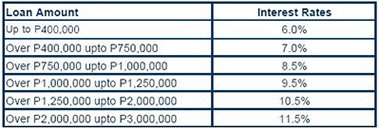
  • Interest rate. This figure is usually expressed as per annum value, likewise known as annualized interest rate. If you are familiar with bank financing, you have probably noticed that the interest rate is different for each bank. In the case of Pag-IBIG Housing Loan, the interest rate is dependent on the loan amount.
  • Loan term. This tells how long the loan is going to be fully paid; also normally expressed in terms of the number of years. In Pag-IBIG Home Financing, the loan term is usually 15 years or 30 years, though, you may also opt for a shorter loan term.

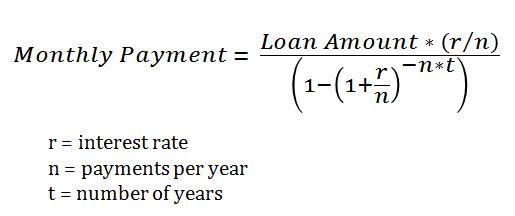
To determine the monthly amortization, we can simply use this equation:

Amortization Equation -- For Pag-IBIG Housing Loans or Bank Loans

Essentially, this amortization formula says that

  • Given a fixed interest rate and loan term, your monthly amortization is directly proportional to the amount of loan. The bigger the loan amount, the bigger the monthly amortization due.
  • Given a fixed interest rate and a particular loan amount, the monthly amortization is inversely proportional to the payment period. The shorter the payment period, the larger the amortization; the longer the payment period, the smaller the monthly payment due.

In other words, while you may be paying a higher monthly amount for a 15-year mortgage compared to a 30-year mortgage, the primary advantage to you is that the loan if fully paid in a shorter period of time.

The main advantage of using the formula above is that it is very handy and versatile. Anyone can use it given any amount of loan, loan term and interest rate.

However, a lot of people are simply lost with Mathematical equations. And not amount of explanations will ever want them to use any formula to determine any figure.

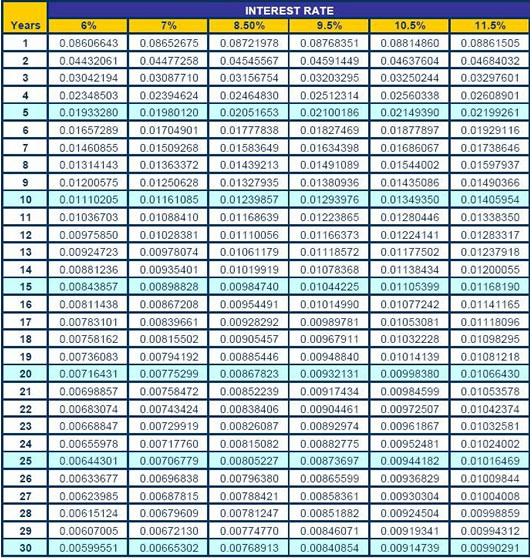
Luckily for them, there is also another way of determining the monthly amortization and that is by using an Mortgage Factors Table such as the one shown below.

The Pag-IBIG Mortgage Factors Table

Take note that this table is made especially for The Pag-IBIG Housing Loan with interest rates effective at the time of this writing (April 2011). You can use it for loan terms starting from 1 year to a maximum of 30 years loan term.

The annual interest rate shown is only the following: 6%, 7%, 8.5%, 9.5%, 10.5% and 11.5%. For interest rates other than these, the table is not applicable anymore. It’s best to use a Mortgage Calculator – a tool which will become available on this website soon.

Pag-IBIG Home Loan Amortization Factors

Given the table above, it is now very easy to determine the monthly amortization by simply following this understandable formula:

Monthly Amortization = (Loanable Amount) x (Factor Rate)

Sample Computation

Consider this hypothetical case: You are buying a Pag-IBIG Home worth P 1.2M and you are planning to put a down payment of P 240,000 which is 20% of the selling price. How much then would be the monthly amortization if you are to pay it is 15 years? How about if the loan is to be paid in 30 years?

Please be guided by the formula above and the interest rates of Pag-IBIG Housing Loan shown below.

Pag-IBIG Housing Loan Interest Rate

From the case in point and looking at the Factor Rates shown at the Table, we can gather the following:

Loan Amount: 960,000 (this is Price 1,200,000 less Down Payment of 240,000 )

For 15-Year Mortgage, the Factor Rate = 0.00984740.

Monthly Amortization (in 15 years) = (960,000) x (0.00984740) = 9,453.50

For a 30-year mortgage, the factor rate = 0.00768913

Monthly Amortization (in 30 years) = (960,000) x (0.00768913) = 7,381.56

When using this formula, take note we are not putting into consideration some other trivial payments like fire insurance, mortgage redemption insurance, membership dues and others. We are leaving that for the sake of simplifying the illustration.

***

Update: A more detailed article about the Amortization and Mortgage Calculator has been made on this website. Please check it now.

~~~

“Pag-IBIG Housing Loan Amortization Demystified” is written by Carlos Velasco.

Filed Under: Housing Loans, Real Estate Finance Tagged With: Amortization, Amortization Schedule, Housing Loan, Interest Rate, Pag-IBIG Housing Loan, Pag-IBIG Mortgage

Foreclosure Properties — To Buy Or Not To Buy? (Part 2 of 2)

by Pag-IBIG Financing Admin

This is the second of a two-part article series on Pag-IBIG Foreclosure. Here we’ll talk about why foreclosure happens and some useful tips on buying foreclosure properties, more specifically, Pag-IBIG foreclosed properties.

(In case you missed Part 1, follow this link.)

Why Foreclosure Happens?

There are endless reasons why foreclosures occur, but basically they all boil down to the following categories.

1. Property Problems. This is perhaps the biggest reason why Pag-IBIG Foreclosures abound. We all know that a lot of Pag-IBIG accredited projects are low cost (read: low-budget) and this leads the developers to resorting to all kinds of dirty tricks just to recover the cost of doing the project.

In Pag-IBIG Subdivisions with high foreclosure rate, it is not uncommon to see the following:

  1. Half-cemented road. You may think they are leave the other half for the next election, but the reality it, the politicians have nothing to do with the project.
  2. Weak structures, sub-standard materials. Houses whose walls are not supported by cables or back doors that are so easy to break any grade school level Karate Kid can do it.
  3. Flooded area. These happen to projects done by fly-by-night developers, the kind of developers who should not be developing subdivisions in the first place.

The list could go on.

Can you blame the buyers if suddenly they stop paying the amortizations and allow the foreclosure clock to just tick? These are reasons enough not to buy in these places even if you see a good deal.

stop pag-ibig fund foreclosure

2. Personal Reasons. People change. Their situations also change. From changing careers to migrating to another country and all else in between, some of life events could drastically affect one’s decision on whether to continue with the property or just let it go.

3. Financial Problems . The money matters no one dares to talk about… until it’s too late.

  1. Disease — We Filipinos are so used to the familiar phrase, “Bawal magkasakit.” It doesn’t require a rocket scientist to figure out that getting sick and being hospitalized for a longer time is really expensive.
  2. Death – If disease is already expensive, death is even more so.
  3. Divorce – Good news: We don’t have divorce here in the Philippines. Bad news: We do have our own strange ways of breaking up a relationship (which should not be made in the first place). Yes, we do break up only after several black eyes are already obvious. Funny huh? Wait until you see what happens to the couple’s real property, which by the way is considered conjugal property

As you can see there are many things and events that could possibly lead to a foreclosure. Therein also lies the problems and opportunities of foreclosure properties.

To Buy Or Not To Buy?

Unfortunately, there is no single best answer. If you know what you are doing and you get lucky enough in choosing a foreclosure property to buy, then good for you. One of the factors foreclosure properties are drawing a lot of interests from buyers, investors and speculators is that their prices appear so very cheap.

However, don’t be misled by the cheap price tag that comes with the property. That Foreclosure property you’re eyeing to buy may contain a bag full of tricks that may not be obvious at first. Always do your homework when considering foreclosure properties.

The following tips should serve as your handy and useful guide when buying a foreclosure.

  1. Uncover the reason of the foreclosure. If possible, meet the owner during the pre-foreclosure stage. You may not get an honest reply, but there are a lot of things you will discover during the conversation.
  2. Get the numbers and do the math. How much is the outstanding balance? What is the monthly amortization? How much was paid so far? What is the selling price? It should be negotiable.
  3. Take a look at the property. Get a second look. Then finally, a third look. Never rely on the map, or the photos or the descriptions of the property. In other words, don’t trust what you are seeing unless it is the property itself. Do some leg work. This process alone is already a potential source of stress, but you have to be aware that this is part of the cheap price you are paying. One of the disadvantages of foreclosure homes is that it is very difficult to inspect what’s inside the house especially if there are still occupants living in the house.

And most importantly, don’t do it alone. Always have a competent lawyer by your side to help you along the way.

“Part 2 of Foreclosure Properties — To Buy Or Not To Buy?“ is written by Carlos Velasco.

Filed Under: Buying Tips Tagged With: Foreclose, Foreclosure

Foreclosure Properties — To Buy Or Not To Buy? (Part 1 of 2)

by Pag-IBIG Financing Admin

In one of the past articles posted on this website, I warned first time Pag-IBIG Home buyers to avoid buying foreclosure properties or even those which are for assume. I reasoned that many of these properties are so problematic to the point of being useless.

Well, they are not really useless if you know what you are doing and you want to take on a little challenge in the hope of reaping the rewards that lie ahead.

Caution:The above paragraph is only for savvy real estate investors. If you are a first time buyer, I still maintain that you should avoid it altogether. When buying your first home, you should treat the whole process as though you have limited financial resources and that you have to make sure you won’t regret doing so later on. As I’ve said many of these properties are inherently problematic that they’re not even worth checking.

This article is an attempt to elaborate on that point a little further.

Recently, we received a letter from one of the website visitors stating her problem with the foreclosure property she bought at Pag-IBIG. I want to share with the readers of this website a portion of that letter to illustrate the most common problem encountered by buyers who have bought Pag-IBIG foreclosed units. Please take note that I have intentionally removed the name and places mentioned in the original letter to keep her privacy protected.

Here goes…

…I’ve been a member of the Fund for almost 16 years now. In 2007, I purchased a foreclosed property in [place not mentioned]. We paid it in cash. To my aghast, the previous occupant refuses to leave the property despite several notices from your office [Pag-IBIG Branch not mentioned] to vacate the property. Your office here advises us to file a case against the previous occupant which we eagerly do so believing it will only be a couple of months and the property will be turn over to us. But until this day, we haven’t taken a hold of the house we legally bought at your office. We knew before paying the unit that Pag-Ibig will not participate in “driving out” whoever is occupying the house. Only that, justice is so slow paced. The counsel of the previous occupant believes that house conflicts of this kind should be settled first with the HLURB and that whatever is the decision of the RTC is immaterial. He cited the MAgna Carta for Homeowners. Natatakot po kami ng husband baka po matalo kami paano na po ung binayad namin sa pag-ibig. Malaki na po ang nagastos namin sa kasong ito. Sobra pa sa binayad namin sa pag-ibig.

The title is already transferred in our name as well as the tax declaration.

What is our chance of winning the case? May case ba na gaya sa amin na nanalo ang buyer ng foreclosed property nyo? …Thank you.

Pag-IBIG Fund Foreclosure HomeI don’t how you feel after reading that one, but the first time I read it, I already felt sorry for the buyer. Of course, I read it for several times more making sure that I understood the real problem the letter sender is facing.
It is very unfortunate that cases such as these are not readily available in the mainstream media. It maybe because it’s very shameful being victimized this way. Adding insult to the injury, the Pag-IBIG Fund can’t even assist buyers in successfully handling the case.

This is the first part of the series of articles on Pag-IBIG Foreclosure Properties. In the next article, I’ll show you some tips and traps of buying foreclosure properties from the Pag-IBIG Fund.

Update: Part 2 is now ready. Please read it here.

~~~

Foreclosure Properties — To Buy Or Not To Buy? is written by Carlos Velasco

Filed Under: Buying Tips Tagged With: Foreclose, Foreclosure

On Collateral And The Pag-IBIG Housing Loan

by Pag-IBIG Financing Admin

Can you imagine life without mortgage loans?

To say the least, only a very few families would be living in their own homes. The reality is, most people can’t really afford to pay Spot Cash on a piece of property. Even a 2-year interest-free, installment payment is still hard on the average family’s budget.

But thanks to financing programs like mortgage loans (or housing loans), many families now enjoy having a roof over their heads while still paying the property over a series of monthly payments on a longer term.

The concept is actually very simple. Given the appraised value of the property, a lending institution can assist the buyer in purchasing the property by financing part of the price. Normally, the lending company may shoulder up to 80% of the property’s price and the borrower should be able to raise the 20% cash down payment.

See also :

  • Fundamentals of Mortgage Loans
  • The Pag-IBIG Housing Loan Process

Pag-IBIG Member Benefits and Responsibilities

As a member of the Pag-IBIG Fund, one of the benefits you can enjoy as member is becoming eligible for Pag-IBIG Housing Loan and paying it in longer periods of up to 30 years.

One of the most important things you need to understand about Pag-IBIG Housing Loan, or any mortgage loan for that matter, is that, it is a secured form of financing. This means that when you sign a housing loan with Pag-IBIG, there are two points that you need to keep in mind:

  • You promise to repay loan on time as set in the agreement.
  • You put the property as collateral to backup your pledge.

The moment you fail to pay on the scheduled monthly amortization, that’s when the Foreclosure clock starts to tick.

It’s a very stressful event and you should do everything in your capacity to contact the Pag-IBIG Fund branch where you applied for the housing loan before it’s too late.

Collateral Requirement of Pag-IBIG Housing Loan

You should already know that Pag-IBIG Housing Loan is only applicable to residential types of properties; not commercial properties.

The collateral requirement of Pag-IBIG Home Loan is very simple: A clean Title (TCT/CCT) issued by the Registry of Deeds.

Important points to remember:

  • The tax on the real property must be updated.
  • The borrower is required to submit a copy of tax receipts.

Furthermore, the following properties / Titles are not acceptable as collateral:

  1. Free / Homestead / Miscellaneous Sales Patent Titles
  2. Properties with Encumbrances
  3. Properties with Liens

See the following related articles:

  • Income and Pag-IBIG Housing Loan Entitlement
  • Pag-IBIG Housing Loans And Foreclosures

Buyer, Beware

Take note of the above-mentioned list of “unacceptable collateral” because they are very important especially if you are buying from individual sellers; that is, not from developer corporations.

When buying a property, insist on getting a copy of the Title — (TCT for Lot, or CCT for condominium unit). Once you have it, verify its status at your local Registry of Deeds. Always avoid buying properties that belong to any of the three categories mentioned above.

Foreclosure properties are another type of properties you should avoid at all costs until you have educated yourself already on the whole idea. However, if you are not that confident yet, forget about all those money-making schemes they preach in Foreclosure Seminars. These properties are much more complicated and a much more painful investment than seminar experts would want to believe.

~~~

“On Collateral And The Pag-IBIG Housing Loan” is written by Carlos Velasco.

Filed Under: Buying Tips, Housing Loans, Real Estate Finance Tagged With: Collateral, Foreclosure, Mortage Loan, Mortgage, Pag-IBIG Housing Loan, Title

How To Check If You Are Qualified For A Pag-IBIG Housing Loan

by Pag-IBIG Financing Admin

“Am I qualified for a Housing Loan?”

This is a recurring question which appears on this website as comments under different articles with different topics. This article is intended to address that question once and for all and also show you some useful tips.

You can actually personally determine if you are eligible for a housing loan based on the following:

  • Your Pag-IBIG Membership
  • Your Age
  • Your Capacity To Pay
  • Other Pag-IBIG Loans

We’ll try to elaborate each one on the succeeding paragraphs.

Your Pag-IBIG Membership Status

You need to remember the following basic requirements for Pag-IBIG Fund Members.

  • You must be an active Pag-IBIG member for at least 2 years and has contributed a minimum of 24 monthly contributions.
  • Both the principal borrowers are subject to the above mentioned requirement.
  • Up to three Pag-IBIG Members may avail of a single housing loan (same collateral) provided they are related within the second civil degree of consanguinity.

Question: Can I pay 24 months one-time and then avail of the Pag-IBIG Home loan immediately?

Answer: Not anymore, the new Pag-IBIG Law of 2009 has changed the rule. But, you may still pay 24-months one time (Pag-IBIG will be more than happy to accept it) and wait for another 24 months to apply. (Other branches will allow you to wait for just 12 months.)

Pag-IBIG Financing Tips on Membership:

  • To re-activate your Pag-IBIG Membership is very simple: just pay for the monthly contribution.
  • If you have been moving from one company to another, always make sure that you consolidate your Pag-IBIG contributions past and present. You can do this by requesting it from the Pag-IBIG Office.
  • Don’t be in a hurry to get a housing loan. You need to establish a good record so that your application will be easier by the time you do it.
  • Read the article entitled “Why This Question Is Wrong: ‘Can I Pay The Whole 24 Months Contribution One-Time So That I Can Avail of the Housing Loan?’“

For the complete list of document requirements, please check this article.

Your Age

  • You must not be more than 65 years old at the time of loan application.
  • You must not be more than 70 years old at the date of maturity.
  • You must be insurable.

Advanced age really is a hindrance to getting a housing loan. And take note that this is true whether you are using Pag-IBIG or any Bank.

Pag-IBIG Financing Tip: If you can afford it, apply for a housing at a young age.

Your Capacity To Pay

Pag-IBIG Housing Loan InterestAs a general rule, your monthly amortization should not exceed one-third of your gross income. This is the rule used by many financial institutions when qualifying a loan applicant.

But when it comes to Pag-IBIG Financing, your monthly amortization (principal + interest) should not be more than 40% of your Net Disposable Income.

Actually, there is a table that you can use to determine much loan amount you can get given your income, contributions and loan term. To see the Table, please refer to the article on “How Your Income And Contributions Affect Your Housing Loan Entitlement”.

Pag-IBIG Financing Tips:

  • Have your finances in order by saving enough for the Down Payment (or Equity).
  • You need to show some proof of income. Prepare the following documents: Pay Slips, Income Statements, Employment Contract (with indicated salary).
  • Learn about the 5’s of Credit
  • If your income is insufficient, you may take on a relative (within the second civil degree of consanguinity) or your spouse and tack-in your contributions then apply for a housing loan.

Other Pag-IBIG Loans

  • You are only allowed one Housing Loan at a time. If you want to take another one, you have to pay your existing loan.
  • If you have previously availed of the housing loan, make sure that it was not foreclosed, cancelled, bought back, or subjected to dacion en pago.
  • If you have an outstanding Multi-Purpose Loan, your payments must be updated and it must not be in arrears at the time of application.

It is important that you take note of the information presented here before you apply for a housing loan from Pag-IBIG.

And if you are disqualified for some reasons, please remember that Pag-IBIG is not the only Home Financing option available. Or, you may want to try applying again in the future. Your loan application may be approved by that time.

~~

“How To Check If You Are Qualified For A Pag-IBIG Housing Loan” is written by Carlos Velasco.

Filed Under: Buying Tips, Housing Loans, Real Estate Finance Tagged With: dacion en pago, Membership, Pag-IBIG Loan, Pag-IBIG Membership

  • « Go to Previous Page
  • Go to page 1
  • Interim pages omitted …
  • Go to page 8
  • Go to page 9
  • Go to page 10
  • Go to page 11
  • Go to page 12
  • Interim pages omitted …
  • Go to page 15
  • Go to Next Page »

Primary Sidebar

Article Categories

  • Buying Tips (21)
  • Featured Project / Property (13)
  • Housing Loans (39)
  • Membership (17)
  • Other Loan Types (8)
  • Pag-IBIG Fund QA (9)
  • Pag-IBIG Overseas Program (9)
  • Pag-IBIG Savings And Investments (7)
  • Real Estate Finance (32)
  • Tips and Traps (23)

Recently Written

  • Home Construction Loan — Should You Get One From Pag-IBIG?
  • Credit Card and Globe G-Cash — New Ways to Send Your Payment to the Pag-IBIG Fund
  • Pag-IBIG Housing Loan Basics. Plus: Dividends, Lost Land Title, etc
  • 5 Home Buying Strategies When Money is Tight
  • Common House Types in the Philippines
  • Home Ownership And Its Many Benefits
  • House For Sale in Laguna
  • How To Become An Expert in Pag-IBIG Housing Loan in 25 Minutes or Less
  • 3 Stupid Things People Do With Their Mortgage Loan
  • How To Assume A Loan
  • Real Estate Agents: Should You Work With Them?
  • Top 4 Reasons Why You Should Not Buy A House
  • Pag-IBIG Real Estate For Sale, May 2012
  • Email Exchange: Maximum Loan, Reactivating Member
  • Capital Gains Tax, Other Real Estate Fees You Should Know
Pag-IBIG Financing © 2010–2026
This website made by NegosyoBuilder.com